

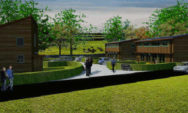
The Welsh Government is embracing low-impact housing with the unveiling of its first village within a village – the Pentre Solar “eco hamlet” within the traditional, stone-walled village of Glanrhyd in Pembrokeshire. The six timber homes have solar panels capable of producing 6000 kilowatt hour per year, low energy use and a A++ energy rating.
Following the successful construction of a prototype house built by start-up Western Solar in 2013, the Welsh Government gave the company £141,000 to help create its nearby production base for the homes, which will house tenants from Pembrokeshire council’s social housing waiting list. With low energy use and access to a shared electric car, Western Solar said residents could avoid up to £2,000 a year on energy costs and consumption.
The eco hamlet was built with insulation material made from recycled paper and local Douglas and Fir wood sourced from the Gwaun Valley. Local people were hired and trained to build the homes, which cost about £100,000 each to build – comparable to a conventional build, according to Western Solar.
About 40% of the fabric of the houses is made in the factory, significantly reducing the build time; it takes only a week to make each house, and less than that to erect it. The company plans to build 1,000 homes over the next 10 years, with the help of partnerships including housing providers and investors.
Welsh Environment Secretary Lesley Griffiths said she was “delighted” to officially open the innovative housing development.
“[It is] not only providing much-needed housing for local people, it is also addressing many other issues such as energy efficiency, fuel poverty, skills development and the use of Welsh timber,” Lesley said.
Low-impact development is recognised by the Welsh Planning system as playing a key role in the transition towards a low-carbon society. Since the ‘One Development Policy’ legislation was introduced in Wales in 2010, it has been possible to build new homes in the open countryside as long as there is a clear commitment for to sustainable living, natural building techniques, and land-based livelihood.…
An ongoing documentary series celebrating sustainable communities and ecovillages around the world is promoting the off-grid way of life. Living in the Future hosts a free online series, a regular blog and a set of three feature documentaries – Ecovillage Pioneers, Lammas and Deep Listening – which follow the development of ecovillages, and communities, around the world.
Ecovillage Pioneers follows filmmaker Helen Iles’s search to find various sustainable, affordable, alternatives to our modern, consumptive way of life. Her journey takes her to a permaculture village in Australia, small communities in Ireland, Somerset and the Gower Peninsula, the more established Findhorn Foundation in Scotland, and the Centre for Alternative Technology in mid-Wales – all projects that inspired Lammas, the UK’s first legal low-impact settlement.
The second film, Lammas: How To build An Ecovillage, shares the highs and lows of the nine trailblazing families who embarked on the pioneering venture to create their homes and a community while dealing with the nightmares of planning applications. After more than six years of planning and construction, Lammas is now a successful off-grid community, spanning almost 50 acres of depleted pasture land in Pembrokeshire, Wales.
Living in the Future’s online series celebrates the innovative and creative individuals who are finding new ways to build self-sustainable houses, including Rachel Shiamh, who won a Grand Designs Award for her two-storey load-bearing straw-bale home in Wales – the first two-storey load-bearing house in the UK, and only the second in Europe.…

Maharishi University plans greenest ever educational facility in Iowa…