 Off-Grid living is the American Dream manifest: “Life, Liberty and the pursuit of Happiness”.
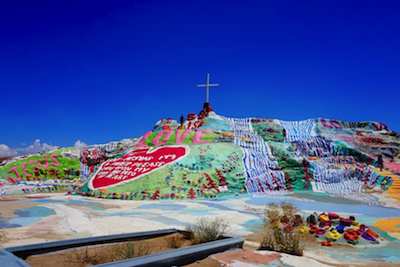
For the residents of Slab City, an encampment in the Sonoran Desert,freedom is paramount. But what happens when the ideal morphs into the un-ideal? Peace and love has been replaced by drugs, strife and Law Enforcement officials. A vision of utopia became dystopian.
The definition of off-grid living according to the Oxford Dictionary is “not using or depending on public utilities, especially the supply of electricity.” Yet if ‘The Slabbers’, as they call themselves, live in “the last free place in America”, what does it mean to be free? And is the sacrifice worth it?
Sandy Parker, an upper class Brit taking American Studies at College, pointed her feet at Slab City, 156 miles northeast of San Diego, whilst studying abroad. She had transferred to a Californian campus to follow her love of 20th century American poets such as Walt Whitman and the Beat Generation, championed by Ginsberg, Snyder, Kerouac and Ferlinghetti.
“I just got the feeling out there that I wasn’t too safe,” Sandy told me later. “… that it was highly dangerous. In London you can walk through a supposedly rough neighbourhood. This neighbourhood had burnt out cars, the roads were terrible and there was extreme poverty around every corner”.
Sandy was a high achiever at school, learned the clarinet and piano from an early age and took ballet lesson as a child. Having been exposed to the wonders of American Studies, and absorbing herself in the sub-culture texts on offer, she now wears her hair in dreadlocks, practices Taoism and veganism. With much anticipation she began her road trip around the USA in Seattle in a hired Toyota Camry, then headed straight for Slab City.
The site was converted by the The Slabbers from an abandoned World War II marine camp to sub-culture commune in the mid-60s. It entered into the mainstream with John Krakauer’s book Into The Wild – Buy it on Amazon (1996) and Original Poster from Sean Penn’s film – Buy it on Amazon.com,(2007)
Both works document the travels of Christopher McCandless who spent time amongst the slabs in the early 1990s whilst journeying up to isolated living in the Alaskan mountains. As for many others, it was these works that drew Sandy to Slab City. However she was acutely aware (having researched the site) that McCandless had arrived at the Slabs when the last “vestiges of a generally safe community” were still visible.
Ecological reasons for off-grid living are not high on the priority list of the average resident in Slab City. When I asked Sandy what problems the residents faced, the issues were both environmental and ideological. Sandy arrived at the edge of a homestead to be greeted by a bullet hole riddled ‘Welcome’ sign. The car thermometer read 44 degrees Celsius. Without electricity and therefore “the …