





The current system of generating electricity centrally and distributing it through the grid wastes as much as sixty per cent of energy -and it ain’t about to get any better, a leading UK academic has told Off-Grid.
He estimated that energy losses in the power grid during generation of electricity are between 45 per cent and 55 per cent, depending on the technology used. The transmission system run by National Grid which does the bulk shipping of electricity in the UK, loses a further two or three per cent. Local distribution networks run by big power companies have losses of between five and seven per cent.
“The local distribution networks have higher losses than National Grid because they operate at lower voltages,“ explained Professor Green.
Limited generating efficiency
But he said that it would be too expensive to make transmission more efficient and that generating efficiency is limited by the laws of physics. “(Transmission efficiency) could be improved if one was prepared to invest heavily in more wires and cables. But frankly it is not the biggest problem facing the industry.”
For networks, the real issues are how to accommodate low-carbon sources, such as wind, and still run a reliable and cost effective system, he said.
The story is very different for generation where he said efficiency is the biggest problem the industry has. “In energy generation you simply cannot achieve 100% efficiency -or anything close to it because of thermodynamic limitations such as maximum operating temperatures.”
However he was anxious to separate the issues of power generation and transmission, which he sees as unrelated, “It is highly misleading to lump generation and transmission networks together and give an overall loss figure because there are two different sets of issues at play and two different approaches needed.”
Of the conventional generating technologies, There are several competing generation technologies and some are more efficient than others, he said. “Combined Cycle Gas Turbines can achieve 55% efficiency or so and beats coal stations which do well to achieve 45%. If one can find a use for the “waste” heat in combined heat and power then the overall [efficiency] can be substantially better,” he says.
But he argued that conventional power sources compared well to newer technologies such as photo-voltaic, “Photo-voltaic panels have efficiencies in the range 10-25% depending on materials and cost.”
For more info or syndication contact news@off-grid.net
Seeing those statistics and efficiency numbers reminds me of a quote I saw recently “87.3% of all statistics are made up on the spot. The rest varies according to the credibility of the narrator”
Having worked in the power distribution field I see evidence of data management as a worst case engineering calculation. What isn’t provided is comparable data showing how efficient alternative and so called grren power sources are. For example it has been said that solar insolation is 1000 watts per square meter. but only at noon when the sun is directly overhead. Why is it then, one of the big solar panels are hard put to deliver only 200 watts at best times. I make that a 20% efficiency. If you calculate the energy needed to create solar panels the stats can get even less optimistic. Payback is often measured in decades.
Just because sunshine is free doesn’t means the conversion equipment is also free.
A properly designed power transmission system should not exceed 5% worst case under highest loading a greatest voltage drop. If it does, it indicates abuse of the system capacity or ageing installations that should be replaced.
Leave a Comment
Creative Commons
license, which allows you to utilise all the information on this site for non-commercial purposes, providing you credit the information with the word 'off-grid.net', which should be written as one word and accompanied by a link to our web site.
View our creative commons license.
View our
Privacy Policy.
We are preparing a TV series for possible broadcast next year. Can you write up your experiences ? Or handle a video camera?
We are looking for people who currently live off-grid anywhere in the world, and for people who want to live off-grid but do not yet do so. This might be in a community or an individual situation. Please send us your videos and photos - or feel free to write about yourself for the web site. Contact nick@off-grid.net
Do you rely on your own healing powers when you are ill? Or is there an unqualified nurse in your local community?
We want to hear from people who do their own doctoring - using their own herbs and remedies, setting their own broken bones, dealing with their own bodies.
Why do you do it? How do you do it? Contact news@off-grid.net
Off-Grid.net is investigating the Utility companies --power, water and waste.
Do the water companies conceal their knowledge of the pollution of the water supply? Do the power companies conceal the wasted energy inside the system, and their excessive profits?
We need help to find the smoking guns: memos, SEC filings,confidential legal advice internal emails..... send to news@off-grid.net. Anonymity guaranteed
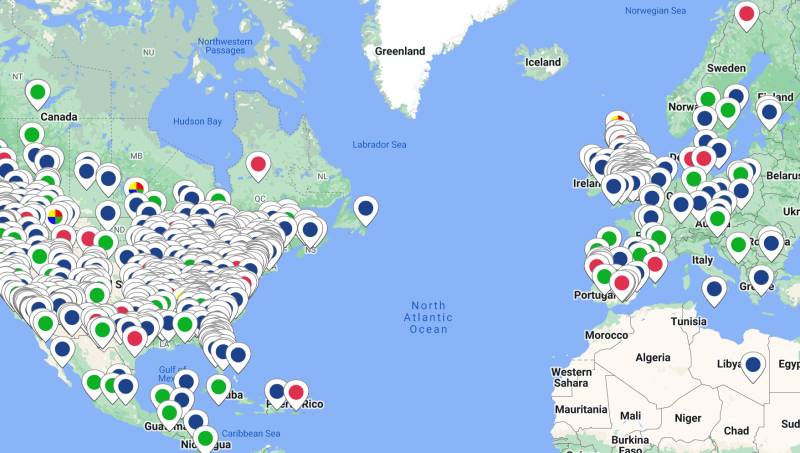
An interactive map showing who wants to go off-grid , and where they are, and who has land on offer.
How it works
1 comment
Seeing those statistics and efficiency numbers reminds me of a quote I saw recently “87.3% of all statistics are made up on the spot. The rest varies according to the credibility of the narrator”
Having worked in the power distribution field I see evidence of data management as a worst case engineering calculation. What isn’t provided is comparable data showing how efficient alternative and so called grren power sources are. For example it has been said that solar insolation is 1000 watts per square meter. but only at noon when the sun is directly overhead. Why is it then, one of the big solar panels are hard put to deliver only 200 watts at best times. I make that a 20% efficiency. If you calculate the energy needed to create solar panels the stats can get even less optimistic. Payback is often measured in decades.
Just because sunshine is free doesn’t means the conversion equipment is also free.
A properly designed power transmission system should not exceed 5% worst case under highest loading a greatest voltage drop. If it does, it indicates abuse of the system capacity or ageing installations that should be replaced.
Leave a Comment