

From the monthly archives:

June 2009

by SuperJoe on June 30, 2009 · 2 comments

in ENERGY

us-army-base
For you, the grid is over
The US Defense Department (DoD) is preparing to make dozens of its key bases across America “off grid ready.”  And apparently in 15 years, all Army bases are expected to be fully off-grid with renewable energy, say military sources – that’s if we are still around in 15 years.

This is a step back from a plan to take all bases completely off-grid immediately, an idea promoted by many military energy experts on security grounds.  DoD’s chief environmental official, Wayne Arny, Deputy Undersecretary of Defense for Installations and Environment, told lawmakers two weeks ago that DOD is split over how far to take the concept of “islanding” bases from the vulnerable national electrical grid, and that a range of options are available that may be preferable to full energy independence.

Sen. Evan Bayh (D-IN), chairman of the Armed Services readiness and management support subcommittee, cited the vulnerability of defense sites to potential terrorist or cyber strikes on the civilian grid, noting at a June 17 hearing that many facilities have just a few days’ backup of reserve generators.

“What’s going on to try and build in some redundant capacity so that, if such an event took place, some of our important DOD facilities wouldn’t be brought down in a matter of days?” he asked defense officials at the hearing sponsored by his subcommittee. Bayh said he believes it could take months before some of the power stations could be brought back online.

In response, Arny said the department is examining the issue. “There’s a great debate going on within the department. Some people have advocated islanding, where we could be completely self-sustained,” he said, noting that over the past decade, DOD moved to privatize its utilities. He continued that the military has tried to ensure that its critical facilities have long-term backup energy sources, and that DOD is looking to benefit from power sources in the vicinity of its installations.

Bayh pressed the matter as one of national security and urged DOD to seek legislative changes if necessary. “This is actually an area where some redundancy, some duplicative capacity may be in order to protect … defense sites, because if we’re completely reliant on the civilian power grid — and that’s vulnerable to attack … then we’ve got to … anticipate that sort of thing,” he said.

Arny said DOD is considering options, and “trying to figure what the middle way is.” He is due to leave his post in the near future, although a replacement has yet to be announced.

The Army, meanwhile, is committed to making all its bases net exporters of energy, using largely renewable and alternative power sources, within 15 years. This would appear to militate in favor of making each base capable of being fully detached from the grid, or “islanded,” for an extended period.

Defense officials were also pressed at the hearing to respond to reported conflicts between the military and private sector over the siting of renewable energy projects such as wind farms near military bases.

“The military is not particularly enamored and some have argued undercut renewable energy projects due to issues like radar signature interference,” a position that has had “a chilling effect on renewable energy projects,” Sen. John Thune (R-SD) told a panel of military officials at the hearing. Thune asked the officials what steps DOD can take to work in concert with the renewable energy industry to allow for more production sites in remote areas.

Arny responded that it is an issue being addressed by the military, noting the need for a compromise and educating base commanders to be more open to such ideas. “We can’t sit there … as a major consumer of energy and say, ‘you can’t produce energy outside my base.’ It’s just incompatible,” he told the subcommittee.

He noted that while DOD cannot do much to prevent the siting of a solar or wind facility on private land, he also had heard of the military “jawboning and causing a chilling effect. We’ve got to reverse that. We have to work with people, look at alternatives.”

At the same time, Arny noted the potentially broader impact of wind farms on some types of military radar, saying that both the wind turbine blades and the wind turbulence they create can disrupt radar. But if DOD needs to have exclusive use of that area, “then we better consider buying easements or buying land. We’ve got to work with people that are trying to produce electricity, especially [photovoltaic] in the Southwest, so that we can accommodate each other, so we understand each other’s problem.”

Thune also questioned the Air Force on its progress in meeting a goal to fill half its domestic aviation fuel requirements via an alternative fuel blend by 2016, particularly given the decision to abandon an initiative to build a coal-to-liquid plant at Malmstrom Air Force base, MT. “[H]ow can the committee help the Air Force reach its goal of using domestically produced alternative fuel?” he asked.

Air Force Deputy Assistant Secretary for Installations Kathleen Ferguson could not provide an answer, and promised to respond in the future.

»Keep reading 'What next, eco-napalm?'

Why I won’t fly to America

June 30, 2009
Why I won’t fly to America

Larch Maxey: can't fly, won't fly An off-grid academic has become a media hero in Britain after he refused to fly to an environmental conference in the United States.

Larch Maxey, Doctor of Sustainability at Swansea University lives in a self built chalet, and does everything he can to keep his carbon footprint low.  He had been offered the all expenses paid trip to attend the Smithsonian Festival in Washington last week to present a paper on global warming.

"If I had flown, it's more than my share of carbon emissions for a couple of years," said Dr Maxey. Instead he presented his paper, 'The Future in Our Hands: Low Impact Development and Sustainability Transitions,' by video link.

»Keep reading 'Why I won’t fly to America'

Madoff-150, Fuld-0, Thain-0

June 29, 2009
Madoff-150, Fuld-0, Thain-0

Fuld - no justice if he walks Bernie Madoff ruined the lives of a few thousand greedy rich people and got 150 years in jail. Yet the SEC ignored the frequent complaints about him for over a decade.  Meanwhile  the disgraced boss of Lehmans, Richard Fuld, who deliberately overstated profits in order to award excessive staff bonuses,has received no penalty for a bankruptcy of over $600 billion - ten times what Madoff stole.  Fuld ignored the advice of accountants and auditors. Recently he sold his $13m mansion to his wife for $100.

He received ZERO years in jail.

And John Thain, the former boss of Merril Lynch earned $83m in 2007, after the company's profits were overdeclared. He received ZERO years in jail.

»Keep reading 'Madoff-150, Fuld-0, Thain-0'

Roll out the rain barrel

June 29, 2009
Roll out the rain barrel

Free water Off-Gridders across the state of Colorado have been waiting a while for this moment - its now legal to gather rainwater off your roof, as long as it is 3,000 square feet or smaller.

But before we all have a barrel of fun, take note: the only people allowed to capture rain are those whose residences are well-ready with a well permit. The mere fact that you have no access to water, are not connected to the water grid, is not enough.

There is still a hill of rules you have to climb for fetching a pail of water.

»Keep reading 'Roll out the rain barrel'

Navajo go solar

June 28, 2009
Navajo go solar

Sacred Power Inc. of Albuquerque has got its hands on half a million dollars of stimulus funding for off-grid power.

It has been awarded a USD500,656 grant through the U.S. Department of Agriculture (USDA) to help bring solar- powered electricity into homes on the Navajo Nation currently without electric power.

»Keep reading 'Navajo go solar'

A town with no cars

June 26, 2009
A town with no cars

Mercedes, Porsche, Audi, BMW, VW. The auto lies at the heart of the German economy and culture. But one small corner has taken a stand against the tyranny of four wheels by creating an entire car-free community.

If you want a car in Vauban, you must buy a parking space in one of the municipal garages on the fringes of town. It’ll cost you close on $40,000, but you wont be able to drive your car anyway

»Keep reading 'A town with no cars'

Free water generator

June 26, 2009
Free water generator

If you are lucky enough to have access to fast moving water on your land, you can use it to generate power.  And there are free plans available on the web for DIY water powered generators (see below).  But be careful only to go to recommended sites.  Bogus companies like Earth4Energy has affiliate deals sweeping the net, selling worthless e-books for $30-75.

»Keep reading 'Free water generator'

Michael Jackson’s Earth Song

June 26, 2009
Michael Jackson’s Earth Song

Michael Jackson in 1995 Michael Jackson sang in his best known environmentally conscious track "Earth Song": "Did you ever stop to notice, the crying Earth, the weeping shores? What have we done to the world?"

This kind of ecological concern from artists was not common at that time (1995). The brilliant video - which was derided by some of the pop press as "hard to understand" featured shots of wildlife and Jackson walking through a burned out landscape.

In 2007 the pop superstar told Ebony Magazine he was "very concerned" about the "international global warming phenomenon."

"I wish they would have gotten people's interest sooner. But it's never too late.....It's been described as a runaway train; if we don't stop it, we'll never get it (our world) back. So we have to fix it, now.

"That's what I was trying to do with Earth Song, Heal The World, We Are The World - writing those songs to open up people's consciousness. I wish people would listen to every word."

»Keep reading 'Michael Jackson’s Earth Song'

Big Energy hand-outs

June 25, 2009
Big Energy hand-outs

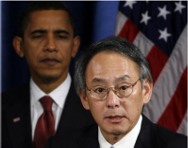
Rabbit in the headlights Energy Secretary Steven Chu delivered a vital speech last night to increase his offer of stimulus bill funding for large energy projects, mainly building new electricity towers. The annual meeting of the privately-owned electric utilities had been disappointed by initial offers from the DoE last month of $20m per project. Chu told them last night that they will get now get $200m per project out of a total pot of $3.9b. By contrast each State is reeiving an average of $20m for energy conservation measures and renewables.

»Keep reading 'Big Energy hand-outs'