
People, places or buildings without mains water or power
 
Subscribe to RSS feed


HomeShopDiscussArchive by month (by subject at end of page)RelaxClassifiedsLogin
Announcement

End of Consumerism

Filed under: — Alexbenady @ 8:48 am


Sorrell: bye bye the Ferrari……..
Advanced industrial countries like the US and UK are moving toward a post-consumer era - less materialist and more spiritual, reports Alex Benady.

The idea that people will stop buying stuff was once the preserve of gloomy anti-globalists. Now a top advertising boss is saying it, you can be sure the party’s over.

In a series of extraordinary and unreported speeches at seminars this year, Sir Martin Sorrell, founder and CEO of WPP, the world’ No 2 advertising group after Omnicom, representing trillions of dollars of consumer spending worldwide, has been announcing what sounds suspiciously like the imminent death of the consumer society in its current form. And other ad execs are joining the chorus.

Sorrell’s speeches

“All our instincts as clients, agencies and media owners are to encourage people to consume more – super consumption,” he told one conference. (more…)

7/31/2008

Use less, pay more

Filed under: — veg-head @ 12:39 am


Record profits and record prices, duh?
At the same time as wholesale Gas spot prices drop 50% within a month, British Gas has raised prices by 35% for 16 million British households.

The gas grid in Britain was built out in the 1970s as a result of the discovery of natural gas in the North Sea. Somehow it was not foreseen that one day the gas would run out and the country would become dependent on imports.

The head of British Gas, Phil Bentley speaking on Radio 4s World at One, had the colossal nerve to say that people would consume less as a result and that was a good thing. He said the firm would be working hard with its poorest customers to ensure their homes were energy efficient. (more…)

7/30/2008

Easy backyard turbines

Filed under: — techstar @ 7:41 am


20 million windy US homes
Turbine makers are starting to promote pint-size installations that can take a house or small business off the grid or take a bite out of an electric bill. For people who live where the wind howls — and where government subsidies can be had — home-brewed wind technology holds promise.

First off, you need a separate tower for your turbine – never try to fix it to the side of your house. Next….. (more…)

7/28/2008

Model home

Filed under: — juiced @ 7:36 am


Laverne Williams - architect
Ten years ago, long before it was fashionable, Bernadell and Stu Thompson built an off-grid ready house in San Antonio, Texas.

Now, everyone wants a tour.

“Even two years ago, we were considered way out there,” Bernadell said. “Now people are coming to us and asking, ‘How did you do this?’”

The 2,200-square-foot energy-efficient home is off-grid ready because solar panels are still too expensive compared to hooking up to the utilities which were already onsite. But that may change next year as costs fall, (more…)

7/25/2008

A Natural Home

Filed under: — Kelly Mead @ 4:09 pm

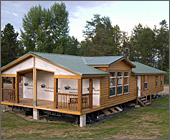
A manufactured log home during construction
Super Good Cents log home, Idaho .
Pioneers living in log cabins were part of American frontier times. Now its part of the new frontier — living a healthy and self-sustaining lifestyle.
The choices available to those wishing to build a log home range from factory pre-cut to handmade on-site. Pre-cut kits are nothing new and have been available since 1923. Most manufactures will allow homeowners to customize their design to make it almost as one-of-a-kind as those handmade on-site.
A plus of log homes is that since most log homes are produced from local renewable wood sources they use much less energy (more…)

7/22/2008

Calculating Possible Energy From A Stream

Filed under: — Kelly Mead @ 5:29 pm

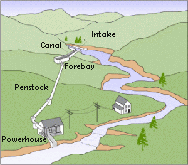
A Typical MicroHydo Power System
A Typical MH set-up on a river.
If you have a stream, you have a renewable, natural source of energy that, if done right, can have little to no impact on the environment around you. Using water as a power source goes back to ancient times. Roman was known to power their empire on it. There is abundant supply of streams and rivers that criss cross the US making micro-hydro power feasible. That is especially true in remote wooded areas where other natural energy, such as solar or wind, would be harder to integrate into the existing environment.

A micro-hydro power system needs a sufficient amount of falling water to be available in order to be feasible. Mountainous and hilly sites are best suited for this type of renewable energy. To figure out the amount of power that is possible from your water source you need to know the head and flow of your stream. The head is the vertical distance of the falling water. While the flow is the speed the water flows at.

A micro-hydro power site usually falls into either a low or high head category. A higher head is better due to needing less water to produce energy as well as the equipment being cheaper than those with a low head. A change in elevation that is less then 10ft (3 meters) is categorized as low head. Anything with a vertical drop less than 2ft (.6 meters) will make a micro-hydro power system not possible. Though if you have as little as 13” of water depth you are able to utilize a submersible turbine, which was originally designed to power scientific instruments being towed behind exploration ships.

There is both a gross and net head that needs to be calculated. The gross head is the vertical distance between where the water enters the penstock, pipes that convey the water under pressure, to where the water exits the turbine. You calculate your net head by subtracting the friction that is caused by the piping and the turbine itself.

While the best way to get an accurate gross head is to have a professional survey of your desired site, you can do a rough estimate yourself. You can use the hose-tube method by taking stream-depth measurements across the width of the water supply you intend to use. Once you know where you intend to place the beginning of the penstock and the turbine you can follow the direction below.

The Hose-Tube Method is done by:

  1. Make sure you have all supplies needed: Someone to help, 20ft to 30ft (6 to 9 meters) small diameter garden hose, Funnel, Measuring tape or yardstick
  2. Stretch the hose down the water channel from desired entrance to the penstock (usually the highest elevation)
  3. One person place the funnel into the hose upstream as close to the surface as possible
  4. At the downstream position have the other person lift their end until the water ceases to flow from it.
  5. Then measure the vertical distance from the surface of the water to the end of the hose. This is your gross head for this section of the waterway.
  6. Then move the funnel end of the hose to where the measurement was taken and once again stretch your hose down the water channel and repeat steps 3 thru 5 until you reach your desired position for the turbine.
  7. Once you have completed your measurements for each section, from entrance to pipes to exit from turbine, add them together for a gross head of the site chosen.
  8. To be conservative in your measurements it is best to subtract 1 – 2 inches (2 – 5 centimeters) from each measurement before adding to account for water that can continue to flow after both ends are level.

The flow of your waterway can probably be found at public sources; such as a U.S. Geological Survey, the U.S. Army Corps of Engineers, the U.S. Department of Agriculture, your county’s engineer, or local water supply of flood control authorities. If the flow is unavailable from these sources you can also do a rough estimate at the site yourself. There are two simple methods for this:

1. The bucket method which involves damming your stream to divert its flow into a bucket or container. The rate at which the container fills is the flow rate. If you used a 5 gallon bucket and it was filled in one minute then your flow rate would be 5 gallons a minute.

2. As long as the water isn’t fast flowing and/or over your calves you can use weighted-float method. This involves measuring the depths of the waterway across its width. To do this you will need: a helper, tape measure, yardstick, weighted-float (a plastic bottle halfway filled with water will do), stopwatch, and graph paper. Then to calculate the flow for a cross section of the waterway at its lowest water level you need to:

  1. Find the most uniform depth and straightest stretch of the waterway
  2. Measure the width of the waterway at the narrowest point
  3. Use the yardstick vertically to measure the depth at 1ft increments. You may wish to use a string stretched across to mark the increments.
  4. Plot the measurements on the paper to give you a cross section diagram of the waterway
  5. Calculate the area of each section by determining the areas of the rectangles (area = length × width) and right triangles (area = ½ base × height) in each section
  6. From the section you measured mark a point at least 20ft upstream
  7. From there release your weighted-float and time how long it takes to reach your measured part of the waterway. Be careful to not let the weighted-float drag on the streambed at anytime.
  8. To get your flow velocity divide the distance between the two points by the seconds it took the float to travel. Doing this multiple times and using the average will you give you a better measurement
  9. Multiply the velocity average by the cross-sectional area of the stream
  10. Finally you need to account for the roughness of the bed of the waterway. You will need to multiple the results by either 0.6, for many rough stones on the bottom, 0.7, for only small to medium stones on the bottom, or 0.8, for a smooth sandy type bottom.

Once you have the flow and head calculations you can estimate the power outage for a standard microhydropower system, which has about 53% efficiency. To do this you multiply the net head by the flow then divide by 10 to get the output in watts.

net head [(feet) × flow (gpm)] ÷ 10 = W

Caution: Please remember that flowing waterways will have variable flows throughout the year. So taking the measurements at the waterways lowest average for the year can ensure that enough energy output is available to support your energy needs.

When you are considering this alternative for your personal energy system you need to consider the power output that is possible, the price, and legal issues, such as water rights and permits. These issues taken as a whole will help decide if this renewable energy is for you. Considering the low impact on the environment, the ability to build it yourself with locally available parts, and the fact that it has been used for thousands of years makes this natural energy stand alone in todays search for alternatives to the conventional power supply.

Gas heat pumps

Filed under: — techstar @ 5:49 am

Introduction

A tried and tested application of mechanical technology to low cost heating and cooling, the heat pump evolved out of cooling applications of the late 1800s, and has developed into technology that can be as reliable as a domestic refrigerator. Heat pumps are a great way to heat buildings and you should consider the use of gas-fired systems as they are cheaper and more efficient than electrically powered ones.

Basic heat pump technology

The technologies used in heat pumps are based on vapour compression systems and absorption systems - both act to move heat from one location to another using energy. (more…)

7/21/2008

Energy independence, one house at a time

Filed under: — Lydia Polzer @ 4:20 pm


We could all be living like Bob
LARAMIE, Wyo. (AP) - When Bob McGovern bought a plot of land west of Laramie, he probably didn’t know the extent to which that land would set him on a course toward self-sufficiency and energy independence. It didn’t take long, however, for ideas to begin brewing in his mind on how to build a house that was “off the grid.”

The nearest utilities to the property are far enough way that McGovern estimates that it would have cost him $25,000 to get service to his house. Instead of forking out that money, he spent time researching everything from small-scale wind turbines to solar panels, battery technology and energy efficiency. (more…)

7/19/2008

Star gazing

Filed under: — techstar @ 6:32 am


Its really, really dark here
A new Astronomical Observatory in Kielder Forest, Northumberland, gets all its power and water from local sources. Kielder is the country’s largest forest, and has the lowest light pollution in Britain.

The world class Observatory is up a 2km farm track and the building’s silhouette shuns the archetypal observatory dome for an angular, constructivist look.

The building’s electricity needs are met by a wind generator and rooftop photovoltaics. Likewise, the plumbing is ‘off-grid’, with no running water. Heating is fuelled with wood from the forest. (more…)