
People, places or buildings without mains water or power
 
Subscribe to RSS feed


HomeShopDiscussArchive by month (by subject at end of page)RelaxClassifiedsLogin

6/27/2008

Grow your own food, make your own fuel

Filed under: — veg-head @ 1:04 pm


Dervaes:poster girls

Imagine all the money you’d save if you did not buy your food at the market, in fact did not buy your food at all! Here’s one family doing just that.

Thelma Gutierrez of CNN spent a day with a family that is self-sufficient, well, self-sufficientish.

The Dervaes family are quite possibly one of the few households in America where rising food prices are not an issue. “You just stay at home and you grow your own food in your backyard,” says URBAN HOMESTEADER, Justin Dervaes. His daughter Anais adds: “We try to cook outdoors using the sun and free energy.”

It takes vegetable oil, heat and some chemicals and makes biodiesel. The Dervaes family of four live off their land, but they do not have a big spread - just a modest three bedroom in Pasadena, California. (more…)

6/26/2008

New UK power plans but no help off-grid

Filed under: — Nick Rosen @ 3:47 pm


Hutton: disappointment

UK householders were warned to expect years of higher home energy bills to pay for a green power revolution. But nobody told them there could be another way. The sly government news machine announced a massive 90% increase in ground source heating - but forgot to mention this takes the installed base from hardly any to not very much.

John Hutton, the Business Secretary, outlined plans for a massive shift away from fossil fuels to wind, solar and tidal power, but added that “We think there will be a cost.”

So now we know - politicians would rather brave announcing an energy price rise, rather than asking voters to reduce their energy consumption.

The new energy policy contains no incentive for off-grid living, even though that is just as good a way of reducing carbon emissions. (more…)

Six ways to save the planet

Filed under: — rooter @ 2:00 am


Stern: relaxed

British academic Nicholas Stern shocked the world last year with his simple statement that we have to pay now for the pollution already done to the planet, or else we will pay a lot more soon. Since then, the bill has already doubled he says. And now he is back with a six point plan.

“The plan is not ambitious in relation to the problem,” he told Prospect Magazine. “It is ambitious in relation to world politics. It has been out for only a few weeks, but has already been picked up by people in ministries around the world.

The proposed deal has six basic elements. “First, we need to cut total world carbon emissions by 50 per cent by 2050, compared to 1990 levels, with rich countries committing at Copenhagen to cut by 80 per cent by 2050. (more…)

6/24/2008

Tide comes in

Filed under: — SuperJoe @ 10:48 am

Tide production facility
The Tide Turns

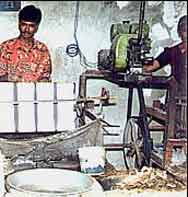
An Indian alternative energy company has been crowned energy champion of the world by a British environmental organisation for its ultra-efficient wood burning stove which will reduce fuel use by 30 per cent.

Bangalore-based Technology Informatics Design Endeavour (Tide) was awarded the title along with a prize of 40,000 pounds by Nobel laureate and environmentalist Wangari Mathai at a ceremony in London.

Another Indian group, the Aryavart Gramin Bank, was among six other international bodies whose schemes were awarded 20,000 pounds each Thursday night by the Britain-based Ashden Awards for Sustainable Energy - the so-called Green Oscars.

Many of southern India’s small businesses rely on wood as their main source of fuel, causing pollution, deforestation and uncomfortable and dangerous working conditions when boilers and stoves are badly designed. (more…)

6/19/2008

Cheap Water Filter for Everyone

Filed under: — Kelly Mead @ 4:58 am

The Australian National University (ANU) scientist Tony Flynn has developed a process to create water filters from commonly available materials. The materials need to also be fired, which can be done without a kiln or other western technology, by using common manure.

An estimated 80% of all sickness in this world can be attributed to unsafe water and sanitation according to the World Health Organization (WHO). That can be seen in the annual 1.5 billion episodes of diarrhea in children under the age of 5, with about four million of those being fatal.

Since historically water filters have had to be imported to developing nations, which means increased cost and reduced availability for the populace. With the new filter design made from common place materials available in even the most remote places.

“These filters are a hollow ceramic vessel filled with charcoal. They are intended to filter out suspended silt and bacteria. However, at around $US5 each, they’re too expensive for individuals in many developing communities to consider purchasing,” stated Mr Flynn. “They are very simple to explain and demonstrate and can be made by anyone, anywhere. They don’t require any Western technology. All you need is terracotta clay, some used coffee grounds or tea leaves, a compliant cow and a match,” Mr Flynn continued “Everyone has a right to clean water, these filters have the potential to enable anyone in the world to drink water safely.”

Filter production is simple:

  • A handful of crushed dry clay
  • A handful of common organic material, such as coffee grounds, rice hulls, or used tea leaves
  • Add water, just enough to make a stiff biscuit dough like mixture
  • Shape into a cylinder shaped pot closed on one end
  • Dry it in sun
  • Place dried filter on a layer of dry manure, a little straw, dead leaves or shredded bark
  • Add two more layers of manure mixture on top
  • Light the straw, dead leaves, or shredder bark
  • Keep fire going until pot is completely cured (less than an hour in most cases, as different materials will mean different times)

Since using a potters kiln can take up to eight to nine hours to achieve the temperatures needed, which can be achieved using this method in a hour or less. Also with the expensive of such a kiln being prohibitive to most people, this is an excellent method anyone can make use of. Especially since no additional technology, or added insulation is needed being able to drink safe, filtered water water in almost any location on the planet. As long as water, manure, red/yellow clay and human organic debris you can make a filter that traps pathogens.

This design is purposely not being patented in a hope that it can be freely used around the world. Their belief that even third world countries should have the ability to have clean safe drinking water.

When the organic material is burned away inside the clay during the firing process it will leave cavities that can trap pathogens in the water. It is based on the basic principal that these cavities are big enough for water to pass through while being too narrow for the dangerous pathogens and the fine materials that make water muddy and unpleasant. Testing was done with E-coli bacterium and saw the filter remove 96.4% to 99.8% of the pathogen, which is well within the recommended safe levels.

This invention came from the a World Vision project that involved the community of Manatuto, in East Timor. This project was to rehabilitate a small community of potters that was devastated in the East Timor’s civil war for Independence. It was hoped that by helping the potters to produce filters would help in two ways; one give the community clean drinking water and two provide a means of revenue for the community by producing and selling them.

Using one filter it was found to produce a liter of clean water in two hours.

I resign from eco-committee

Filed under: — Nick Rosen @ 12:20 am
Eco-town Minister (3rd from left)
Eco-town Minister 3rd from left

The UK administration’s plans for new eco-towns are increasingly threadbare, and Labour ministers are rowing back from earlier commitments. As reported in The London Times, I am therefore resigning from the committee which is supposedly advising the towns on their energy footprint. (more…)

6/18/2008

Planet Greensburg

Filed under: — spy_vondega @ 3:40 pm
Highlighting energy saving?

The tornado-ravaged community of Greensburg will be featured on the launch of Planet Green TV this week. The town was given an eco-rebuild as part of a 13-part documentary series produced by Leonardo di Caprio.

The reality series “Eco-Town” chronicles the rebuild after a tornado flattened Greensburg — which is pretty well in the dead centre of the USA. By all accounts it is pretty tame stuff - Tragedy to Triumph….Greensburg Rising..etc….schmaltzy reprise of the tornado raging at 205 mph, spanning more than a mile and a half and killing 11 people…..happy folk celebrate the rise of the new roof….but of course the town ahs bveeb built with all sorts of energy saving features and that’s a good thing.

Residents won’t be able to view the series, since the city doesn’t have a cable service. The show premieres on Sunday at 8 p.m.

Di Caprio has had film crews in town since July 2007, following residents as they move from temporary trailers to new homes, covering city council meetings and shadowing families as they make the difficult decisions.

The story is told through the voices of the townspeople themselves.

The whole town will go to the Greensburg school gymnasium on Sunday for a Father’s Day barbecue and screening of the first episode.


Information from: The Wichita Eagle, www.kansas.com

6/17/2008

Gore backs Obama - too little too late

Filed under: — Nick Rosen @ 8:19 am
Obama and Gore
Not a great moment

Barak Obama is too good a politician to decline an endorsement from former Vice President Al Gore, yet he must have been tempted to say “thanks, but no thanks.”

Gore pledged Monday to do all he could to help Obama win the White House, but the best thing he could do is stay out of sight until December, preferably beyond.

Gore remained neutral as Obama and Hillary battled over the nomination. Because he held back last February, while Off-Grid and others called on him to endorse Barak, the fight went on longer than necessary, weakening the Democrats’ challenge to Sen John McCain this fall. (more…)

6/15/2008

Be Tankless

Filed under: — Kelly Mead @ 5:50 am

Being tankless in heating your water is an easy, if somewhat costly, upgrade that you can see immediate benefits from. Costs can vary from about $150 for point of use water heater to household ones starting about $450 going up to $1000 or more for top of the line models. Point of use models install directly under the water fixture which also means less heat loss and you can convert your water heating system slowly one water fixture at a time. But since most houses have at least two sink and a tub you will already go over the cost of the cheapest whole house tankless system. On the plus the up front cost can be spread out over time, and for smaller places such as boats, RV’s, campers, etc. it might just be what you are looking for.

The average household spends $50 or more a month just to keep hot water at the ready. This means that the hot water is heated and then stored in it’s tank to wait for use. Just like anything else that id hot and left to sit heat loss happens and then it needs to be re-heated, which just starts the cycle over again. Once the water is used the cycle is again in place till that water is used, and so on. That is a lot of wasted energy you are paying for just to have the convenience of on demand hot water. At that hot water is finite since the average tank system holds about 40 galleons and tankless can supply an infinite supply. Chyanging over to a tankless system lets you use as little or as much hot water as you need without the worry over running out or heating more than needed.

The lifespan of a tankless water heater, 20+ years, is almost double that of a convential water heater, 8 to 12 years, Also a tankless system is serviceable while most tank water systems are not. Tankless systems also can be installed outside your home or in a fraction of the space vacated by your convetnional one. It’s almost like adding a small closet to your home of usable square footage.

The conventional water heater is only about 40% to 60% energy efficient do to the heat loss through the exhaust and the walls of the tank. While tankless are 60% efficient for the gas version and 99% efficient for the electric version. So for those of you who have or are looking to change to personal energy systems this is one less drain of your limited energy production without lossing the comfort of hot water on demand.

For those who use radiant heat, tankless systems can work for you too., They can be installed in RV’s boats,mobile homes, sheds, barns, etc. So the applications seem almost endless for anyplace you need/want on demand hot water production. Plus since there is no storage tank associated with this system you won’t need to worry about it freezing and bursting in frigid temperatures. So there will be no messy floods to clean up as you can have from leaking or broken tank water heater systems.

Venting for theses systems is also flexible as some can be vented horizontally and vertically, some can even be vented through existing chimneys. Most of the newer models also have computer-monitored safety devices with automatic water and gas valves to make them as safe as possible.

Payback for the additional cost of these tankless varieties is 3 to 7 years depending on usage and model bought. If you have a smaller household the payback will be seen faster as you will no longer be constantly re-heating unused hot water. For a larger household the convience of multi-showering, either in a row or at the same time, will be noticed right away. That means no more worrying about when the 40 galleons are used up, about 20 minuets, when you are all lined up in the morning to start your day.

For anyone desiring a better way to have hot water in their home look into these tankless water heater at your local hardware/home improvement store or research models on the net. The benefits definitely outweigh the higher price tag. In addition you are adding value to your home.