
People, places or buildings without mains water or power
 
Subscribe to RSS feed


HomeShopDiscussArchive by month (by subject at end of page)RelaxClassifiedsLogin

5/31/2008

Solar powered cycling

Filed under: — marese @ 10:46 pm
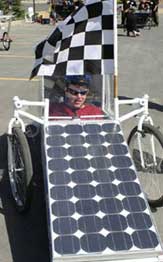
solarbike.jpg
Racing for the sun

Let the sun help you up those hills.

There are a number of bike designs which incorporate a solar powered motor - see links below.

Another option is the pedal-charged battery, which powers the motor which powers the bike.

Check out these sites: (more…)

5/30/2008

Eco second homes

Filed under: — SuperJoe @ 5:49 am
Mohawk Valey view
Consider this

Q: What links Spain with New York’s Mohawk River Valley, 240km-long, beginning just west of the state capital, Albany? A: They have both seen a sudden rush in eco-developments.

Safflyn Corporation is planning a $53m housing project with 100 solar and wind-powered homes surrounded by athletics fields, walking trails, a golf course and driving range.

Manhattan-based Caledonia Advisors picked urban Utica on the Upper Mohawk, 370km north-west of New York City. (more…)

STOP WRITING MONTHLY CHECKS TO NOSFERATU

Filed under: — Kelly Mead @ 5:20 am

by Mark Jeantheau, GrinningPlanet.com
Vampire Power – Wasted Standby Power in Home Electronics and Appliances

When we say “vampire power,” we don’t mean the hypnotic power of some black-caped, white-fanged Transylvanian. We mean the electricity your  home electronics and appliances suck out of the power grid when you’re not using them. (Of course, we realize that the TV has a certain hypnotic, vampirish power over us, but that’s a different problem.)

If you’re a conscientious user of appliances and gadgets, you always turn them off when you’re not using them. But many electronics don’t actually go all the way off—they continue using “standby power.” Some examples of features that require standby power are:

  • internal clocks and sensors;
  • external clock displays and panel display LEDs;
  • remote control sensors;
  • battery rechargers and power-conversion packs;
  • communications between a base unit and a portable unit (as in a portable phone).

This article provides some statistics on how much vampire power is costing you and offers tips for reducing your vampire-power problem in the future.

VAMPIRE POWER TAKES A BITE OUT OF YOUR WALLET


Not all of this vampire power is truly wasted—after all, many of the features in modern electronics that require standby power are either critical for proper functioning of the unit or are associated with desirable features. Most wasted standby power is consumed by inefficient power supplies and components that are getting power unnecessarily. An Australian study of global standby power usage in electronic devices estimated that electronics manufacturers could reduce vampire power by 30% right off the bat just by using existing, better technologies—and with minimal additional cost to consumers.

WHERE DO THE VAMPIRES DWELL?
Exact figures on total losses to standby power are not available, but the most recent major survey on the subject estimated that in the United States, 5% of electricity usage is due to standby power. In Europe, the numbers run slightly higher: France at 7% and Germany and the Netherlands at 10% each. Australia comes in at 11%, Japan at 12%.

The amount of standby power wasted varies among electronic equipment, but overall, the cost to consumers and businesses for all the electricity lost to vampire power in the US is estimated to be $4 billion annually. The International Energy Agency (IEA) estimates the global energy consumption due to standby power at between 200-400 terawatts per year.


Depending on the efficiency of your unit’s design, the standby power use can be minimal or substantial. And even though home electronics aren’t typically the biggest electricity users in a house, vampire power can still cost you up to 10% of your electric bill.

To some extent, vampire power is only one factor in overall power use for electronic devices. Different units can vary in their “in-use efficiency” too. So really, what we want to look at is the overall energy efficiency of the unit, whether it’s off or on, and get an estimate of the total power likely to be consumed by a typical consumer over an average year.

DRIVING A STAKE THROUGH THE HEART OF VAMPIRE POWER

The US EnergyStar program has done a lot to empower consumers by providing energy efficiency ratings for various categories of electronics. To get the EnergyStar label, products must meet stringent energy-efficiency criteria. So, when you shop here in the US, make sure the product is EnergyStar-rated. For some categories, such as refrigerators and freezers, there will also be a numerical efficiency rating that can help you further narrow your choice.

The EnergyStar web site has a slew of pages designed to help you find models that qualify for the EnergyStar label. Each product page gives an overview of the energy considerations for the particular electronics category, provides a mini-search engine to help you find brands that qualify, and give information about other important product characteristics that will help you make smart purchases. Product pages are available for many categories; we list the most popular ones below.

HUNT DOWN THOSE
BLOODY POWER DRAINERS!
There’s a cool little gadget available that can help you determine which of your plug-in items are the most inefficient power consumers.  It’s the Kill-A-Watt electricity usage monitor. You just plug it into the wall outlet and then plug your electrical device into the Kill-a-Watt monitor. It will allow you to assess how efficient the electrical device is. You can calculate the item’s electrical cost by the day, week, month, or year to help you decide whether a more efficient model would save you money over time. Check out the Kill-A-Watt monitor at Amazon.com
  • Consumer electronics, like TVs, VCRs, and DVD players, as well as cordless phones and phone/answering machines;
  • Computer and office equipment, including CPUs, monitors, printers, scanners, fax machines, copiers, and water coolers;
  • Major appliances like refrigerators, freezers, dishwashers, and clothes washers;
  • Heating, ventilating, and air conditioning (HVAC) equipment, as well as fans, dehumidifiers, and air purifiers;
  • Light fixtures and compact fluorescent light bulbs (CFLs).

Go to the EnergyStar web site

VAMPIRE POWER — WRAP UP

 When you replace a piece of electronic gear that’s got a big vampire-power factor with one that’s more efficiently designed, you save money over the long run. But remember, since power plants produce pollution when they generate electricity for you, reducing wasted vampire power also helps reduce pollution. We’ll all breathe easier when the power vampires are dead!

Know an energy ghoul who might like this Vampire Power article? Please forward it to them.


© Mark Jeantheau/Grinning Planet. More great articles at www.grinningplanet.com

About the Author
Mark is a writer, financial analyst, web developer, environmentalist, and, as necessary, chef and janitor. Mark’s web site, Grinning Planet, is an expression of his enthusiasm for all things humorous and green, as well as a psychotic desire to work himself to death. Hobbies include music, healthy eating, getting frustrated over politics, and occasionally lecturing the TV set on how uncreative it is. Mark lives in Kentucky in the USA.

MILF denies attack

Filed under: — Julienne Dolphin Wil @ 12:35 am
muslimwomenholdindignati.jpg
Protest against attack

ZAMBOANGA CITY – A bombing attack on the offices of the Philippines off-grid energy authority has been laid at the door of Moro Islamic Liberation Front (MILF). (more…)

5/29/2008

Making homebrew diesel

Filed under: — veg-head @ 10:12 am
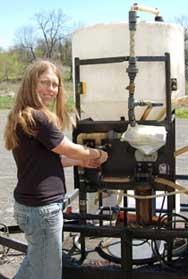
woman makes Biodiesel
DIY Biodiesel kit

There is a booming cottage industry of people making their own biodiesel from waste cooking oil. With the help of special equipment and the addition of a several chemicals, anyone can do it. Lower down this story we tell you exactly how to make it.

Remember – it only works in Diesel vehicles. (more…)

Growing Your Own Vegetables And Rearing Your Animals Organically

Filed under: — Kelly Mead @ 6:10 am

By : Harwood E Woodpecker  

The way that we look at food has changed over the past 10 – 15 years, for many people cheap mass produced fast food is just not acceptable in their diets any longer as they now understand more about the implications of how the food was produced, what it does to our body and the ethics that have gone into the production of the food. For this reason more and more of us are turning to growing our own vegetables and even having a go at rearing our own animals for meat and food. This all ties in very nicely with the boom time that cookery is having at the moment due to the increase in cookery programs on the television. We are more educated about food and how to cook it than ever before and with the help of the inter web we are never far away from some exotic recipe or another. So what can you do to join the growing number of people that are becoming self sufficient and more educated in what we eat and the way we produce our food?

Growing your own vegetables is pretty simple stuff really; all you need is the correct tools of a spade, a fork and a hoe and then a plot of land in which to grow your crops. It really is that simple; many of the everyday crops such as potatoes, carrots, beans and cabbage have been cultivated over hundreds of years and developed into crops that are usually pretty hardy and easy to grow. Certain things are important to ensure that you get a plentiful crop such as a good fertilizer, a good compost and good pest control all of which are easily sorted but decisions have to be made at an early stage as to which way you would like to go, organic gardening or conventional gardening.

The trend at the moment is leaning towards organic gardening for the simple reason that you have gone to all of the effort in deciding to grow your own vegetable crops so you might as well go the whole way and produce your crops in an organic way. Organic gardening is not that much more difficult than conventional gardening, it only takes a little more research and time to carry out but the rewards make it all worthwhile.

Rearing your own meat is a little bit more tricky than growing your own organic vegetables but after the initial settling in period where you are learning the basics it is relatively simple to have your own little farm going that takes up very little time. The most popular animals to raise on a home farm are chickens and pigs, chickens take up less space and are a little easier to look after and pigs need more space and take a bit more of your time up. The extra work that is needed to look after the pigs is more than rewarded by the amount of food that the pigs produce but depending on the space you have available both animals are more than manageable.

Both chickens and pigs are fairly low maintenance and the benefits of rearing these animals far out-weighs the disadvantages, as well as the effort that is put into keeping these animals for food you will have the added advantage of being educated about how to keep the animals in a humane way which will help you and your family understand the true value of meat and food.

Keeping chickens and pigs has other benefits such as the manure that they produce can be used to fertilize your garden and help your vegetables to grow, helping you to have a truly organic gardening experience.


 Author Resource:- For more info on organic gardening and organic compost please visit our site - www.organic-baby-toys.com

5/28/2008

Powering villages from rice husks

Filed under: — Lisa @ 11:28 pm
Gyanesh Pandey
Gyanesh Pandey

It could be the start of a new paradigm – The Indian Dream. A local lad chucks in a high-paying job on the West Coast to bring light to a remote village in Bihar, India.

Villagers saw the light when Gyanesh Pandey came home from Los Angeles. Together with friends from the University of Virginia, he raised funds, built a rice husk generator and empowered the village. (more…)

Pump my ride!

Filed under: — Nick Rosen @ 6:12 pm
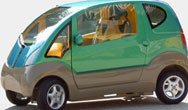
MDI air powered car
Air powered car

Tata, India’s largest automaker has started production on the world’s first commercial air-powered vehicle. Some 6000 zero-emissions Air Cars are scheduled to hit Indian streets in August of 2008. The move is to be welcomed because threatens the hegemony of big oil companies and oil producing nations. It may also do something to reduce pollution in big cities. The US will see an air car next year if the Scuderi Group in Massachusetts is successful. It has raised about $15 million from friends and family and is pushing ahead “in spite of being laughed at by large investment banks at first,” said President Sal Scuderi.

“Here’s a tiny firm saying we’re going to change the internal combustion engine,” he said. “After positive evaluation reports there are many less skeptics now; (more…)

12 Herbs that Act Like Medicines

Filed under: — veg-head @ 1:34 pm
Red Pepper medicine
Rx red pepper

You probably already use these ingredients in your home,but they can do more than just making meals tastier. Here are some common foods that do double duty as effective herbal treatments with impressive health benefits.

Fits in nicely with the organic gardening tips and recipes in the book, Grow Your Own Pharmacy. (more…)